




















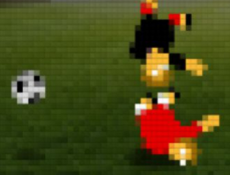
A Small World Cup is a simplified football game where players control a single character or small team in short matches. The gameplay focuses on direct interaction with the ball using basic movement and jumping mechanics. The objective is to score more goals than the opponent within a limited time. The structure is minimal, allowing players to enter matches quickly and repeat them without preparation. Each session is independent, with results based on timing and positioning.



A Small World Cup
Advertisement
Advertisement




A Small World Cup is a simplified football game where players control a single character or small team in short matches. The gameplay focuses on direct interaction with the ball using basic movement and jumping mechanics. The objective is to score more goals than the opponent within a limited time. The structure is minimal, allowing players to enter matches quickly and repeat them without preparation. Each session is independent, with results based on timing and positioning.
Core Movement And Ball Control
The main mechanic involves moving a character across a small field while interacting with the ball. Controls are limited to directional input and a jump or kick action, depending on the version. Players must position themselves correctly to intercept or strike the ball.
Physics plays an important role. The ball reacts to contact, angle, and force, creating unpredictable movement. Players adjust their actions based on how the ball bounces or changes direction during play. This requires continuous attention rather than fixed patterns.
Match Structure And Flow
Matches are short and typically last a few minutes. The field is compact, which keeps both players in constant interaction. There are no complex rules such as fouls or formations, and gameplay continues without interruptions.
Scoring is straightforward. Each goal increases the player’s count, and the match ends when time runs out. The simple structure allows quick transitions between matches and encourages repeated play.
Main Gameplay Elements
- Small-scale football matches with simplified rules
- Direct control of a single character or unit
- Physics-based ball movement
- Short match duration with quick restarts
- Continuous play without complex interruptions
Difficulty And Variation
Variation comes from opponent behavior and player input rather than changing mechanics. Matches may feel different depending on how the ball moves and how the opponent reacts. Some versions include different teams or visual themes, but the core system remains unchanged.
Difficulty is based on control and timing. Players improve by learning how to position themselves and anticipate ball movement. There are no additional layers such as upgrades or progression systems.
Player Experience And Replay Loop
A Small World Cup is structured around rapid, repeatable sessions. Each match begins under similar conditions, allowing players to focus on improving their performance. There is no long-term progression, and success is measured by match outcomes.
The experience emphasizes consistency and reaction. By playing multiple matches, players refine their ability to control movement and respond to ball physics. The game creates a loop where engagement depends on repetition, adjustment, and direct interaction within a simple competitive format.
Comments (0)


2026
