







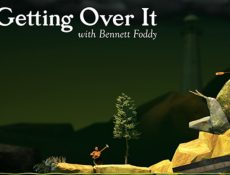
Get Over It is a physics-based platform game built around precise movement and constant trial and error. The player controls a character sitting in a cauldron who can only move using a hammer. There are no traditional controls such as jumping or running, and progress depends entirely on how well the player understands momentum and angle. The game begins in a simple environment but quickly introduces complex terrain that requires careful positioning and patience to overcome.



Get Over It
Advertisement
Advertisement


Core Mechanics And Control Scheme
The main mechanic of Get Over It is the hammer, which is used to push, pull, and lift the character across obstacles. Movement is based on mouse control rather than buttons, meaning small hand movements can lead to large in-game consequences. The physics system is intentionally unforgiving, making precision more important than speed. There are no checkpoints, so falling means losing progress and repeating previous sections. This design encourages learning through repetition rather than memorization.
Progression And Player Interaction
Progression in Get Over It is linear but highly unstable. Each area introduces new shapes and surfaces that require different movement approaches. The player must adapt continuously, as the same technique rarely works in every situation. The game does not provide tutorials or hints, leaving players to discover mechanics through experience. Common gameplay elements include:
- Using momentum to climb vertical surfaces
- Balancing the hammer on narrow edges
- Swinging between objects to gain height
- Controlling movement after long falls
- Recovering from mistakes without checkpoints
These mechanics form a loop where success depends on control and persistence rather than upgrades or abilities.
Level Design And Environmental Structure
The level design in Get Over It is built as a single continuous climb rather than separated stages. Environments change gradually, shifting from natural terrain to abstract structures. Each section introduces new spatial challenges while building on previously learned skills. The lack of visual boundaries between areas reinforces the idea of a single uninterrupted journey, making every mistake feel significant because of the distance that can be lost.
Audio And Presentation
Sound design plays a supportive role in the experience. The game features calm background music and occasional spoken commentary that reflects on failure and perseverance. Visuals remain simple, keeping attention focused on movement and physics rather than decoration. The minimalist presentation helps ensure clarity, allowing players to read surfaces and angles without distraction.
Comments (0)


2026
