










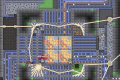
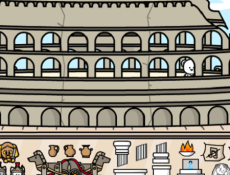
JMKit Doll House: Roman Colosseum is a browser-based creative playset that invites players to arrange characters and objects within a themed environment inspired by Ancient Rome. The game does not include objectives, scoring, or progression systems. Instead, it provides a static arena backdrop and a collection of elements that can be placed freely. The activity centers on composition and spatial arrangement, allowing users to create scenes without time limits or conditions for success.



JMKit Doll House: Roman Colosseum
Advertisement
Advertisement








JMKit Doll House: Roman Colosseum is a browser-based creative playset that invites players to arrange characters and objects within a themed environment inspired by Ancient Rome. The game does not include objectives, scoring, or progression systems. Instead, it provides a static arena backdrop and a collection of elements that can be placed freely. The activity centers on composition and spatial arrangement, allowing users to create scenes without time limits or conditions for success.
Scene Layout And Environment
The Roman Colosseum acts as a fixed stage that frames all interaction. Its architecture defines the visible space, offering open areas and structural features that guide placement without enforcing rules. Nothing in the environment moves or reacts on its own, and there are no scripted events. This stability allows players to focus entirely on how elements relate to one another visually. The background remains consistent across sessions, providing a familiar canvas for repeated scene building.
Elements And Placement Mechanics
Interaction in JMKit Doll House: Roman Colosseum relies on selecting items from menus and positioning them directly within the scene. Each object functions independently and can be moved or removed at any time. The available content typically includes:
- Character figures that can represent different roles
- Animals suitable for arena-based scenes
- Props such as tools, weapons, or banners
- Architectural or structural additions
- Decorative items used to fill empty space
These elements can be layered and rearranged freely, giving players control over depth and composition.
Creative Freedom And User Choice
The game does not define how scenes should look or what they should represent. Players may aim to recreate imagined Roman scenarios or focus purely on abstract arrangements. Because there are no constraints on placement, experimentation is central to the experience. Objects can overlap, be repositioned repeatedly, or be excluded entirely. This freedom allows users to refine their scenes gradually, changing layouts until the desired arrangement is achieved.
Controls And Ease Of Use
Controls are designed to be simple and visible at all times. Players interact using mouse or touch input, dragging items into place with no need for keyboard commands. There are no penalties for mistakes, and changes can be made instantly. This approach makes the playset accessible regardless of experience level, as all interaction is based on direct manipulation rather than hidden mechanics.
Comments (0)


2026
