









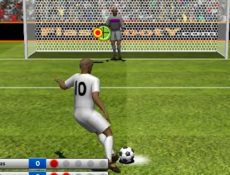
Penalty Fever 3D is a football game focused entirely on penalty shootouts. Instead of full matches or team management, the gameplay centers on short, intense moments where precision and timing decide the outcome. The player alternates between taking shots and defending the goal, creating a loop that feels fast and direct. The structure makes the game easy to start while still requiring attention and coordination to succeed.



Penalty Fever 3D
Advertisement
Advertisement






Gameplay Structure And Flow
The game is built around a simple round system where each turn consists of a single penalty kick. When shooting, the player must choose direction and timing carefully to avoid the goalkeeper. When defending, the task switches to reading the opponent’s movement and reacting quickly. Rounds progress one after another with increasing difficulty, making each successful goal or save more important. The absence of long breaks keeps the pacing consistent and focused.
Controls And Core Mechanics
Penalty Fever 3D uses straightforward controls that rely on quick input rather than complex combinations. The challenge comes from predicting outcomes rather than mastering buttons. As the game progresses, shot speed and variation increase, requiring sharper reactions. Key actions during gameplay include:
- Selecting the direction of a shot
- Timing kicks to avoid blocks
- Moving the goalkeeper at the right moment
- Reacting to fast or deceptive shots
- Completing short penalty sequences
These mechanics repeat in cycles, encouraging players to improve timing and consistency rather than memorizing patterns.
Difficulty Progression And Challenge
Difficulty in Penalty Fever 3D increases gradually. Early rounds allow room for error, but later stages demand precise control and faster reactions. Opponents become less predictable, and goalkeepers react more quickly. The game does not introduce upgrades or power-ups, so improvement depends entirely on player skill. This creates a learning curve that feels natural and rewards repeated attempts.
The visual presentation is clean and functional, allowing players to focus on the action without distractions. Player models and goal areas are clearly visible, making it easy to judge distance and direction. Animations are smooth and readable, helping players understand shot outcomes instantly. The interface remains minimal, showing only necessary elements such as score and turn indicators.
Comments (0)


2026
