













Shinkansen 0 is a first-person anomaly detection game developed by Chilla’s Art. The gameplay takes place inside a moving bullet train where the player navigates through a sequence of repeating cars. Instead of combat systems or traditional survival mechanics, progression depends on identifying visual inconsistencies within the environment. The structure relies on a loop model that requires sustained observation and accurate decision making. Access to new areas is determined by correctly interpreting anomalies rather than completing objective markers.



Shinkansen 0
Advertisement
Advertisement










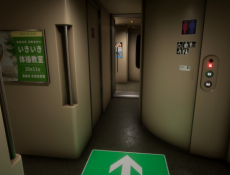
Shinkansen 0 is a first-person anomaly detection game developed by Chilla’s Art. The gameplay takes place inside a moving bullet train where the player navigates through a sequence of repeating cars. Instead of combat systems or traditional survival mechanics, progression depends on identifying visual inconsistencies within the environment. The structure relies on a loop model that requires sustained observation and accurate decision making. Access to new areas is determined by correctly interpreting anomalies rather than completing objective markers.
Observation-Driven Progression Model
Player advancement is governed by a rule-based movement system. Each train car functions as a checkpoint that must be evaluated before proceeding. When anomalies are detected, players must reverse direction; when environments appear unchanged, forward movement is required. Incorrect decisions trigger resets, reinforcing pattern recognition and environmental memory. This framework encourages players to scan surroundings methodically, as anomalies may involve minor object shifts, altered lighting, or unexpected character behavior.
Environmental Variations And Detection Cues
Visual repetition is a core design component. Train interiors maintain consistent layouts while introducing subtle deviations that influence player decisions. Detection cues are embedded directly into the environment, requiring players to compare details across multiple cars.
Primary anomaly categories include:
- object placement irregularities
- lighting or texture modifications
- signage and poster changes
- passenger presence variations
- spatial configuration shifts
These variations require attention to fine visual details. The absence of interface-heavy guidance ensures that recognition skills drive gameplay rather than system prompts.
Rule Shifts And Adaptive Decision Making
As progression continues, the game introduces contextual changes to movement logic. Certain sections alter directional rules, preventing reliance on fixed patterns. Players must adapt by reassessing environments instead of applying repetitive strategies. This variation in rule application modifies pacing and increases cognitive demands. The design emphasizes flexibility, requiring players to interpret both visual anomalies and situational mechanics simultaneously.
Comments (0)


2026
