














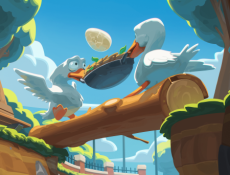
An Eggstremely Hard Game is a physics-based cooperative platformer about geese trying to bring a fragile egg home. The main objective is to carry the egg through a continuous course filled with platforms, gaps, slopes, and other obstacles without breaking it completely. There is no traditional story campaign with dialogue or missions. Progress comes from moving farther through the course, learning how the egg behaves, and coordinating with other geese.


An Eggstremely Hard Game
Advertisement
Advertisement



An Eggstremely Hard Game is a physics-based cooperative platformer about geese trying to bring a fragile egg home. The main objective is to carry the egg through a continuous course filled with platforms, gaps, slopes, and other obstacles without breaking it completely. There is no traditional story campaign with dialogue or missions. Progress comes from moving farther through the course, learning how the egg behaves, and coordinating with other geese.
Carrying the Egg
The egg reacts to every impact. Each crack makes it weaker, more unstable, and harder to control. A damaged egg can become wobblier and bouncier, so sections that were manageable at the beginning become more difficult after several mistakes. If the egg slips away or falls, players can still recover it and continue instead of restarting immediately.
Cooperation and Movement
Players need to coordinate movement while keeping the egg under control. They can also interact directly with each other, which creates additional ways to cross difficult sections. Main gameplay actions include:
- carrying and protecting the egg;
- moving across narrow platforms;
- jumping over gaps and obstacles;
- recovering the egg after it falls;
- lifting another goose;
- throwing teammates to new positions;
- using physics to move through difficult sections;
- continuing while the egg becomes increasingly damaged.
Obstacles and Difficulty
The challenge comes from physics and precision rather than enemies or combat. Players need to judge movement carefully because sudden turns, jumps, or collisions can damage the egg. At the same time, the geese themselves use intentionally awkward physics-based movement, so controlling both the characters and the egg requires practice.
There are no conventional levels with separate combat encounters or upgrade systems. The course acts as the main challenge, and progress depends on reaching farther sections while keeping the egg intact enough to continue. The basic gameplay loop consists of picking up the egg, carrying it through obstacles, recovering from mistakes, helping teammates reach difficult positions, and slowly advancing toward the end. As more cracks appear, the same movement becomes less predictable, making later sections harder even without introducing traditional enemies or weapons.
Comments (0)


2026
