






















Bloodmoney Requiem is a psychological horror clicker and visual novel built around an uncomfortable question: how much suffering are you willing to cause when your own survival depends on the money you earn? What initially looks like an absurdly simple clicking game gradually turns into a disturbing experiment in greed, desperation, and personal responsibility. The rules are easy to understand, the goal is clearly defined, and the person standing in front of you seems harmless. What makes the game difficult is not learning how to play it, but deciding how far you are prepared to go.



Bloodmoney Requiem
Advertisement
Advertisement












BLOODMONEY: Requiem
You desperately need $25,000 for an expensive medical operation. There is no complicated treasure hunt and no conventional job that can solve the problem quickly enough. Instead, you encounter Harvey Harvington, a cheerful man operating a small roadside stand with an unusual offer. Every time you click him, you receive money. At the beginning, one click earns only one dollar. Harvey is friendly, the interaction appears harmless, and earning money seems almost comically straightforward.
The problem becomes obvious once you realize how many clicks it would take to reach $25,000 at that rate. Fortunately, the game provides ways to increase your income. Unfortunately for Harvey, those methods become increasingly cruel.
One Dollar at a Time
The basic gameplay of BLOODMONEY: Requiem revolves around clicking Harvey to earn cash. The mechanic is intentionally simple because the real complexity comes from the decisions surrounding it. You always understand what produces money, and you always know why you need more of it. The question is whether reaching the required amount justifies the methods available to you.
At first, earning a dollar per interaction feels innocent enough. Harvey willingly participates in the arrangement, and nothing about the colorful presentation immediately suggests how ugly the situation can become. But making $25,000 through harmless clicking alone requires patience. The game knows that players will naturally begin looking for a faster solution.
That desire for efficiency is exactly where the horror begins.
Instead of forcing the player into cruelty immediately, BLOODMONEY: Requiem presents increasingly profitable possibilities. More aggressive actions can produce more money per click. The financial advantage is obvious, and every improvement makes the final target appear much easier to reach.
You are therefore constantly balancing two numbers that cannot be separated from each other: how much money you want to earn and how much pain you are willing to inflict to earn it.
Harvey Harvington Is More Than a Button
Harvey is the center of the entire experience. Mechanically, he is the character you interact with to generate money, but treating him purely as a resource is exactly the mindset the game wants to examine.
He speaks, reacts and remains visibly present while you make your decisions. The more extreme your actions become, the harder it is to pretend that you are simply optimizing numbers in an ordinary incremental game. Harvey is not an abstract health bar or a disposable enemy standing between you and an objective. He is the person whose suffering directly translates into your financial progress.
This relationship creates the central tension of BLOODMONEY: Requiem. The interface encourages the logic of a clicker: maximize profit, find better methods and reach the target efficiently. The narrative constantly reminds you what those improvements actually mean.
Every additional dollar becomes connected to something happening to Harvey.
The Shop Changes Everything
Progress introduces options that can dramatically increase the amount of money you receive. This creates the game’s most important temptation. You could continue using slower methods, but once faster alternatives become available, deliberately ignoring them requires restraint.
The shop effectively turns morality into an economic decision.
A new purchase is valuable because it can increase your earnings, shortening the distance between your current balance and the $25,000 objective. From a purely mechanical perspective, better income is obviously desirable. BLOODMONEY: Requiem then forces you to look at what “better” actually means in practice.
As the available methods become more severe, the numbers rise alongside them. Suddenly the operation that initially appeared impossibly expensive seems achievable. You can watch your balance increase much faster, but Harvey pays the difference.
The game does not hide this exchange behind complicated systems. The relationship is brutally direct: more suffering can mean more money.
A Clicker Where Efficiency Has Consequences
Most incremental games reward optimization without asking the player to consider what their increasing efficiency represents. Bigger numbers are normally an unquestionable improvement. BLOODMONEY: Requiem takes that familiar structure and turns it against the player.
You want each click to become more valuable because repeating the weakest interaction thousands of times is inefficient. Once you start thinking in those terms, Harvey can gradually become less of a character and more of an income source.
That transformation is part of the psychological horror.
The game does not need an enormous collection of complicated mechanics because its central system already creates the necessary conflict. You know exactly why the profitable option is attractive. You also understand exactly who suffers when you choose it.
There is no need to calculate an abstract moral score. You can see the result directly.
Cute Colors, Increasingly Horrible Actions
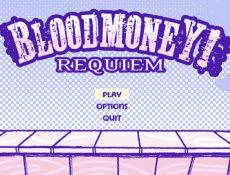
Visually, BLOODMONEY: Requiem deliberately clashes with its subject matter. Its hand-drawn, pastel presentation initially makes the game look playful and harmless. Harvey’s appearance and the roadside setup do not resemble the environments normally associated with psychological horror.
That contrast is intentional.
As the situation becomes more disturbing, the cheerful visual identity remains part of the experience. Bright colors and cute character art exist alongside increasingly violent actions, making the escalation feel even stranger. Instead of transitioning into a conventional dark horror aesthetic, the game corrupts something that originally looked safe.
Requiem completely redraws the art of the original BLOODMONEY!, giving the familiar scenario a remastered presentation while preserving the uncomfortable contrast that defines the game.
The result is horror that does not depend on dark hallways or realistic monsters. Much of the discomfort comes from watching a colorful, seemingly innocent interaction become progressively harder to justify.
You Need $25,000 — But How Will You Get It?
The medical operation gives the protagonist an understandable reason to want money. You are not collecting cash simply because a score counter exists. According to the premise, obtaining the money is connected directly to your own survival.
That detail prevents the central choice from becoming completely trivial.
If the protagonist merely wanted to become rich, refusing to hurt Harvey would require little consideration. Instead, BLOODMONEY: Requiem creates a situation where the player has something important to lose. The money has a purpose, and failing to obtain it carries its own consequences.
This does not automatically justify every available method. Instead, it makes each escalation more complicated.
The game repeatedly asks you to decide where necessity ends and greed begins. Once you discover that greater suffering creates greater profit, are you doing only what is required to survive, or are you choosing the fastest path simply because it is available?
That distinction increasingly depends on your own actions.
Your Choices Determine the Direction of the Story
BLOODMONEY: Requiem is not built around one unavoidable sequence of events. The way you approach Harvey and the decisions you make affect how the experience develops.
Multiple endings give those decisions a concrete result. There are more than three possible endings, meaning the final outcome is connected to the path you take rather than being identical regardless of your behavior.
This makes experimentation an important part of replaying the game. A player who immediately pursues maximum profit can experience the story differently from someone who deliberately avoids the harshest methods. Different approaches reveal how much the game’s outcome depends on what you were willing to do along the way.
The endings also reinforce the fact that the money counter is not the only measurement that matters. Reaching a financial objective does not automatically mean that everything ended well.
Psychological Horror Without Traditional Survival Mechanics
There are no complicated combat systems required to make BLOODMONEY: Requiem disturbing. Its horror comes primarily from participation.
The game gives you direct control over actions that become increasingly uncomfortable, and then allows you to continue clicking. You cannot easily separate yourself from what happens by saying that a cinematic forced the protagonist to do it. The interaction is deliberately simple and direct.
You click.
You receive money.
Harvey experiences the consequences.
Then you decide whether to click again.
That repetition is what gives the game its uncomfortable rhythm. Every interaction is mechanically easy, yet the meaning behind those interactions changes dramatically as the situation escalates.
The Remade BLOODMONEY! Experience
Requiem is not simply a small continuation of the original game. It includes a full remake of the 2025 BLOODMONEY! experience, with its visual presentation completely redone.
For players discovering the series for the first time, this means Requiem provides the central scenario that established Harvey Harvington and the game’s unusual money-for-clicks concept without requiring knowledge of the previous release.
Returning players can revisit the familiar premise through newly created artwork while also seeing how the final version expands on ideas established by the original.
The fundamental conflict remains immediately recognizable: you need money, Harvey can provide it, and greater rewards are available if you are willing to treat him worse.
What begins as a ridiculous roadside transaction slowly becomes something much darker.
The New Requiem Campaign
The package goes beyond remaking the first game by introducing an entirely new Requiem storyline. This additional campaign expands the experience rather than simply presenting the original scenario with updated graphics.
That makes BLOODMONEY: Requiem both a remake and a continuation. The original premise establishes the rules and the relationship between money, Harvey and the player’s decisions, while the new material provides another round built around the consequences and themes of the series.
For players already familiar with BLOODMONEY!, the Requiem campaign is the major new reason to return. You are not simply replaying exactly the same sequence with cleaner artwork. There is additional story content designed specifically for this release.
Together, the remastered original and the new campaign form the final main entry in the BLOODMONEY! series.
Money Makes Every Decision Easier — Until It Doesn’t
The most effective part of the game’s design is how clearly it demonstrates the temptation of increasing rewards.
One dollar does not sound like much. Two dollars is better. Four is better again. Eight is even more attractive. Once your income begins increasing, returning to the slowest possible method can feel irrational from a gameplay perspective.
That is precisely the trap.
The game encourages the same optimization instinct that players bring to ordinary clickers, then attaches increasingly disturbing consequences to that instinct. You may begin thinking about Harvey in terms of profit per click rather than as a person. A more brutal method can become attractive simply because it saves time.
The interface gives you numbers. The story gives those numbers a cost.
There Is Always Another Click
BLOODMONEY: Requiem works because the player is rarely confused about what they are doing. Its moral pressure does not come from hiding the consequences behind obscure systems. You can understand the basic transaction immediately.
The challenge is stopping.
Once you have already crossed one boundary, the next one may become easier to justify. If you have already hurt Harvey to increase your earnings, another upgrade can seem like only one more step. The difference between the current method and the next may feel smaller than the difference between doing nothing and making the first harmful choice.
That gradual escalation allows the game to transform the player’s behavior without changing its fundamental controls.
You are still clicking the same character.
What changes is what those clicks are doing to him.
More Than a Joke Clicker
The premise is intentionally absurd, and BLOODMONEY: Requiem frequently uses exaggerated presentation and dark humor. But underneath that surface is a very specific gameplay idea.
The game takes the fundamental reward loop of an incremental game and asks what happens when optimization has a visible victim.
You still experience the satisfaction of watching your earnings increase. You still unlock methods that make progression faster. You still have a large numerical target that you want to reach.
But every improvement forces you to confront the source of that increased efficiency.
That makes the game simultaneously easy to play and uncomfortable to complete. Mechanical progress and narrative deterioration can happen at exactly the same time.
Multiple Endings Encourage Different Approaches
Because the game contains multiple endings, finishing one route does not necessarily show everything Requiem has to offer. Different decisions provide a reason to return and test another approach.
What happens if you prioritize money above everything else? What changes if you show restraint? How much can you earn without choosing the most extreme options? Is reaching the target the only thing that should determine whether a run was successful?
These questions become more interesting after completing the game once because you already understand how quickly the situation can escalate. A second playthrough allows you to deliberately establish boundaries that you may not have considered during the first.
The simplicity of the clicking mechanics makes replaying different paths straightforward, while the narrative consequences give those runs different meaning.
Harvey Remembers What the Player Is Doing
Harvey’s importance comes from the fact that he remains the human face of the entire system. You are never simply purchasing abstract upgrades in isolation. The consequences return to the same person who originally offered you an innocent one-dollar deal.
His presence prevents the game from completely becoming a mathematical optimization exercise. Even when you begin thinking about the fastest way to increase your balance, the visual novel elements continually bring the interaction back to Harvey himself.
This is why the escalating methods matter. The game wants you to notice the difference between the friendly man you encountered at the beginning and the situation you may create through your own decisions.
The money counter moves upward while everything else can move in the opposite direction.
A Short Game Designed to Stay in Your Head
BLOODMONEY: Requiem does not need dozens of hours to establish its idea. Its clicker structure, visual novel storytelling and branching decisions are concentrated around a very specific scenario.
That focus keeps the central question visible throughout the experience.
You need $25,000.
Harvey gives you money.
You can make him give you more.
How you accomplish that is where the actual game exists.
The simplicity also makes every decision easy to understand. There are no enormous skill trees or complicated statistics distracting from the relationship between action and consequence. When you choose a more profitable method, you know why you chose it.
Whether you feel comfortable with that reason is another matter.
How Far Would You Go for Money?
At its core, BLOODMONEY: Requiem is about the distance between needing something and deciding that your need justifies whatever you do to obtain it.
The game begins with desperation. You require an operation costing $25,000, and Harvey Harvington unexpectedly offers a possible solution. His roadside clicking business appears almost impossibly convenient: interact with him and receive money.
Then the game introduces efficiency.
Faster methods produce better rewards. Better rewards bring the operation closer. The target that once seemed unreachable begins shrinking rapidly, but only because Harvey is paying an increasingly severe price for your progress.
From there, the direction of the story belongs to the player. You can decide which opportunities are worth using, how aggressively you pursue the money and where you draw the line. Those choices feed into multiple possible endings and determine what kind of story your playthrough becomes.
With completely redone pastel artwork, the remade content of the original BLOODMONEY!, a new Requiem campaign, branching outcomes and the same deceptively simple clicking concept at its center, BLOODMONEY: Requiem turns earning money into a psychological horror scenario where the most important resource is not cash. It is your willingness to continue.
The game gives you a target of $25,000 and a button you can keep pressing.
What happens between the first dollar and the final one depends on what you are prepared to do to Harvey to get there.
Comments (0)


2026
