

























Big Walk
Advertisement
Advertisement





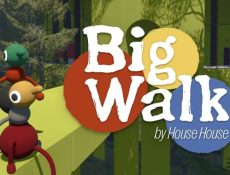
Big Walk is a cooperative multiplayer adventure from House House, the creators of Untitled Goose Game. Instead of building the entire experience around combat, collecting better equipment, or completing a long list of repetitive objectives, Big Walk focuses on something much simpler: exploring an unusual world together with your friends. Players are dropped onto a strange island filled with paths, landmarks, puzzles, hidden areas, and unexpected discoveries. The challenge is not only figuring out where to go, but also learning how to communicate and cooperate when the game deliberately gives you plenty of opportunities to become separated.
The result is an adventure that feels more like going on a bizarre trip with friends than participating in a traditional multiplayer mission. You can wander away from the group, investigate something interesting in the distance, attempt environmental challenges, or simply spend time messing around with the game’s communication mechanics. Big Walk gives players objectives and places to discover, but it also leaves enough freedom for spontaneous moments to become an important part of the experience.
Explore a Huge and Unusual Island
The island is one of the most important parts of Big Walk. Rather than pushing everyone through a narrow sequence of rooms, the game encourages players to look around and decide where they want to investigate next.
Interesting structures and landmarks can appear in the distance, immediately giving your group something to walk toward. Along the way, however, someone will inevitably notice another path, strange object, or possible shortcut. A simple journey from one location to another can quickly turn into an adventure of its own.
Exploration therefore feels social. You are not only discovering the environment—you are constantly discussing what everyone has found and deciding whether the group should stay together or split up.
Getting lost can even become part of the fun.
Communication Is Part of the Gameplay
Big Walk places unusual emphasis on communication between players. Talking to friends is not simply something happening outside the game while you complete objectives. Communication itself is integrated into the experience.
Distance matters. Players have ways to communicate across the environment, but staying connected with the rest of the group can become its own challenge when everyone starts exploring independently.
This creates situations that would not happen in a standard multiplayer game. Someone may disappear while investigating an interesting location. Another player might be trying to explain what they have discovered from somewhere else on the island. The group then needs to work out how to find each other again.
These mechanics make Big Walk particularly suited to playing with friends rather than silently completing objectives alongside strangers.
Solve Problems Together
Throughout the adventure, players encounter different challenges that encourage cooperation, observation, and experimentation.
Not everything immediately explains itself. Your group may need to inspect the environment, test ideas, and communicate possible solutions. Instead of one person simply following a waypoint while everyone else watches, the game encourages players to participate.
One person might notice an important detail that everyone else missed. Someone else might understand how part of a puzzle works. Another player may accidentally discover the solution while doing something completely unrelated.
Those moments make cooperation feel natural rather than forced.
Getting Distracted Is Half the Experience
Big Walk does not feel like a game where efficiency should always be your priority.
You could probably agree on a destination and attempt to reach it as quickly as possible, but that would mean ignoring much of what makes the adventure entertaining. The environment constantly gives players reasons to become distracted.
See something strange?
Go investigate it.
Notice another path?
Follow it.
Lose your friends?
Now finding them becomes the next adventure.
This freedom creates stories that belong specifically to your group. The funniest memory from a session may have nothing to do with completing an official objective. It could simply be the moment someone wandered away and the entire group spent the next several minutes trying to work out where they had gone.
Built for Playing With Friends
The strongest element of Big Walk is its social design. Many multiplayer games technically allow friends to play together but still give each player essentially the same individual tasks. Big Walk tries to make the presence of other people meaningful.
Communication, navigation, exploration, and problem solving become more entertaining because another person is involved.
You may disagree about where to go.
You may misunderstand someone’s directions.
You may discover different parts of an area.
And occasionally everyone may have absolutely no idea what they are doing.
That uncertainty is part of the appeal.
A World Made for Curiosity
Big Walk rewards players who look beyond the most obvious route. Its environments are designed to encourage curiosity rather than simply function as corridors connecting objectives.
Landmarks help you understand the world while also tempting you to travel farther. Different locations create natural meeting points and destinations for the group. Meanwhile, smaller discoveries make the journey between those locations worthwhile.
The island gradually becomes more familiar as you spend time exploring it. Places that initially seemed completely unknown begin to function as reference points when communicating with friends.
That growing familiarity makes exploration satisfying without requiring a traditional map filled with hundreds of icons.
Simple Ideas Create Unexpected Situations
Big Walk demonstrates how relatively simple mechanics can produce complicated social situations.
Consider something as ordinary as walking toward a landmark.
One player goes ahead.
Another stops to investigate something.
Someone takes a different route.
The group becomes separated.
Now everyone needs to communicate and find each other.
A basic journey has suddenly created its own miniature story without requiring a scripted cutscene.
This is where Big Walk has the potential to be particularly memorable. The systems provide the tools, but players create many of the funniest situations themselves.
Cooperation Without Constant Competition
Big Walk is not primarily about proving that you are better than everyone else in the group. The focus is on experiencing the adventure together.
That makes it appealing to players who enjoy multiplayer games but are tired of competitive matches, rankings, and constant pressure to perform perfectly. Your friends are companions rather than opponents. Mistakes do not necessarily ruin the experience either. A misunderstanding can become funny. Taking the wrong path can reveal something unexpected. Losing track of another player can create a new problem to solve.
The game leaves room for imperfection, and that works especially well in a social adventure.
Why Big Walk Stands Out
Big Walk takes exploration, communication, and friendship and turns them into the foundation of its gameplay. Its island provides a large playground where groups can travel together, separate, reunite, solve problems, and discover strange places at their own pace.
The game does not need constant combat to create excitement. Sometimes simply reaching your friends can become the objective. A distant structure can create enough curiosity to send everyone across the landscape, while an unexpected discovery can completely derail whatever plan the group originally had.
For players who enjoyed the playful design philosophy behind Untitled Goose Game, Big Walk offers another unusual idea from House House, this time built around sharing the experience with other people.
Gather your friends, head onto the island, and start walking. You might have a destination in mind when you begin, but in Big Walk, what happens on the way there is likely to become the most interesting part of the journey.