






















Track and Field is built around a sequence of athletic events where each discipline uses the same small set of controls in a different way. There is no story campaign, character development, or exploration between competitions. The player takes control of an athlete and tries to meet the qualifying standard in every event, with performance measured through times, distances, and cleared heights. Failing to qualify can cost a chance, while successful results allow the competition to continue.



Track and Field
Advertisement
Advertisement







Track and Field is built around a sequence of athletic events where each discipline uses the same small set of controls in a different way. There is no story campaign, character development, or exploration between competitions. The player takes control of an athlete and tries to meet the qualifying standard in every event, with performance measured through times, distances, and cleared heights. Failing to qualify can cost a chance, while successful results allow the competition to continue.
Build Speed Before the Action
Running events use rapid button presses to increase the athlete’s speed, while a separate action button handles jumps and throws. In some disciplines, holding the action input determines the angle of the attempt, so reaching maximum running speed is only the first part of the challenge. A fast approach can still produce a poor result if the jump or throw is released too early or too late.
The six main events are:
- 100 Meter Dash;
- Long Jump;
- Javelin Throw;
- 110 Meter Hurdles;
- Hammer Throw;
- High Jump.
Learn the Rules of Each Event
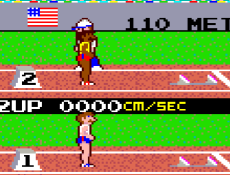
The 100 Meter Dash is the simplest event and focuses almost entirely on building speed from the start to the finish line. Long Jump adds a takeoff line and requires the player to choose a jump angle without stepping beyond the mark. Javelin Throw follows a similar structure, but the action button controls the throwing angle instead of a jump.
The 110 Meter Hurdles combines running speed with repeated jump timing. Pressing the jump control too early or too late can interrupt the rhythm and reduce the final time. Hammer Throw removes the normal running approach and instead focuses on building rotation before releasing the hammer at the correct angle. High Jump uses a controlled approach followed by a timed takeoff, with rapid input in the air helping the athlete gain additional height.
Qualify and Continue
Track and Field does not use conventional levels, but the six events form a fixed progression. Players must meet a qualifying time, distance, or height before moving forward, and later rounds can increase the required standard. Failing too many events ends the current attempt, while better performances can also set new records.
The challenge comes from switching between different types of timing without changing to a complicated control scheme. Sprinting rewards fast rhythmic input, hurdles require speed and repeated reactions, while jumps and throws depend more heavily on release timing and angle. Improving therefore means learning the specific rhythm of all six disciplines rather than mastering only one event.
Comments (0)


2026
