































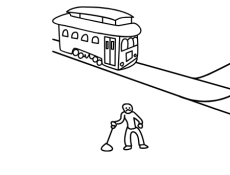
An approaching trolley, two railway tracks, and a lever form the basis of Absurd Trolley Problems. The opening situation adapts a familiar philosophical thought experiment: a runaway trolley is heading toward five people, and changing its direction would place one person in danger instead. Players must decide whether to intervene or allow events to continue. Subsequent levels change the circumstances while preserving the basic decision structure. Some situations introduce recognizable moral questions, whereas others use increasingly strange details to make familiar arguments less straightforward. The game presents each choice independently rather than developing a continuous narrative.



Absurd Trolley Problems
Advertisement
Advertisement









An approaching trolley, two railway tracks, and a lever form the basis of Absurd Trolley Problems. The opening situation adapts a familiar philosophical thought experiment: a runaway trolley is heading toward five people, and changing its direction would place one person in danger instead. Players must decide whether to intervene or allow events to continue. Subsequent levels change the circumstances while preserving the basic decision structure. Some situations introduce recognizable moral questions, whereas others use increasingly strange details to make familiar arguments less straightforward. The game presents each choice independently rather than developing a continuous narrative.
Choosing Whether to Intervene
Every scenario describes the consequences of two possible actions. Players can examine an illustration of the tracks, read the accompanying explanation, and choose how to respond. A player may initially adopt a rule based on minimizing harm, but later situations challenge whether that rule should apply in exactly the same way. Personal responsibility, uncertainty, individual preferences, and the consequences of intervention can all influence the way a dilemma is interpreted.
Different Kinds of Moral Questions
Throughout its sequence of levels, Absurd Trolley Problems introduces variations that encourage players to reconsider earlier assumptions:
- Comparing the consequences for different numbers of people.
- Deciding whether direct intervention changes responsibility.
- Considering the significance of personal belongings.
- Responding to situations involving animals.
- Evaluating uncertain outcomes and unusual conditions.
- Comparing immediate harm with longer-term consequences.
- Facing deliberately exaggerated or humorous dilemmas.
Once a decision has been made, the game reveals how other participants responded. These percentages provide an interesting point of comparison, especially when a seemingly obvious answer produces a divided result. They represent the recorded choices of players, not an official judgment about the moral correctness of a decision.
Completing the Sequence of Dilemmas
The complete experience contains a succession of twenty-eight scenarios, moving beyond the original philosophical example into more unconventional situations. There is no traditional system of character development or equipment collection. Progress is achieved simply by answering the current question and proceeding to the next one. Players may replay the game to reconsider earlier decisions or discuss the scenarios with others. Absurd Trolley Problems combines accessible interaction with ethical reasoning, using humor to demonstrate how small changes in context can produce substantially different reactions to the same underlying choice.
Comments (0)


2026
