






















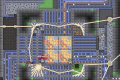

Mini Motorways is a traffic management strategy game where the player builds and changes a road network for a growing city. Houses continuously appear and need routes to matching destinations, such as shops, offices, or other buildings marked with the same color. There is no story campaign or fixed cast of characters. Each game is a self-contained city simulation where the objective is to keep traffic moving for as long as possible while the map becomes more crowded.



Mini Motorways
Advertisement
Advertisement










Mini Motorways is a traffic management strategy game where the player builds and changes a road network for a growing city. Houses continuously appear and need routes to matching destinations, such as shops, offices, or other buildings marked with the same color. There is no story campaign or fixed cast of characters. Each game is a self-contained city simulation where the objective is to keep traffic moving for as long as possible while the map becomes more crowded.
Roads Have to Adapt as the City Grows
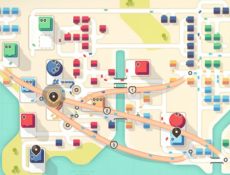
The player draws roads by connecting houses to destinations. Cars automatically follow the available routes, so the challenge is designing a network that prevents congestion. New buildings appear over time, often forcing the player to extend roads, create intersections, or completely rebuild parts of the city. Because road tiles are limited, every connection has a cost and poorly planned routes can quickly use up the available space.
The main gameplay includes:
- drawing and removing roads;
- connecting houses to matching destinations;
- managing traffic congestion;
- using bridges and tunnels to cross obstacles;
- placing traffic lights and roundabouts;
- building motorways between distant areas;
- redesigning routes as new buildings appear;
- trying to keep every destination supplied with cars.
Weekly Upgrades Change the Network
At regular intervals, the player receives a choice between upgrades. These can include additional road tiles, bridges, tunnels, traffic lights, roundabouts, or motorways. The best option depends on the current map. A motorway can solve a long-distance traffic problem, while a bridge may be necessary when water blocks a useful route. Choosing the wrong upgrade can make later expansion more difficult.
Each City Creates a Different Traffic Problem
Mini Motorways does not use traditional levels with scripted objectives. Instead, it offers city maps inspired by real locations such as Los Angeles, Beijing, Tokyo, and Munich. Each map has different rivers, coastlines, mountains, or other obstacles that affect road placement. The city also grows procedurally, so two attempts on the same map can develop differently.
A run ends when one or more destinations become overloaded because cars cannot reach them quickly enough. The score is based on how many trips are completed before the network fails. Progress comes from unlocking more city maps, improving high scores, and learning how to separate traffic, reduce unnecessary intersections, and use limited road-building tools efficiently.
Comments (0)


2026
