






















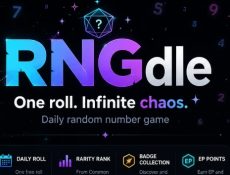
There is no puzzle to solve before RNGdle reveals its answer because the result is created entirely by chance. Once per day, the player generates a random number between 0 and 1,000,000 and then discovers whether that number contains any notable properties. The game examines the result automatically, assigns badges for qualifying patterns, and awards EP, or entropy points. There is no story, controllable character, map, or conventional level system.



RNGdle
Advertisement
Advertisement









From Random Number to Score
The generated number is checked against many possible conditions. Some rolls receive only common badges, while others unexpectedly match several mathematical or digit-based properties at the same time. EP from all earned badges is combined to determine the overall rarity of the number. Because the calculation is based on the result itself, players do not choose upgrades or perform actions to increase the score after rolling.
What the Game Can Detect
Badges are awarded for different kinds of numerical patterns, including:
- prime numbers;
- palindromes;
- repeated digits;
- mathematical sequences;
- recognizable meme numbers;
- additional special number properties.
Each badge also has its own probability-based rarity. The categories are Common, Uncommon, Rare, Epic, Anomaly, and Mythic. Mythic badges are the least likely, appearing in fewer than 0.001% of possible rolls, while more common patterns appear much more frequently and are worth fewer entropy points.
The complete roll receives another classification based on its accumulated EP compared with all possible results. These overall ranks range from Trash and Common through Uncommon, Rare, Epic, Anomaly, and Mythic. A roll can therefore look ordinary but still receive a high classification if it contains properties that are statistically uncommon. Likewise, a visually memorable number is not automatically one of the rarest results.
Collecting Results Over Time
RNGdle is structured around daily participation rather than completing stages. After rolling, players can inspect the badges they earned, add new ones to their collection, and share the result. Returning on later days provides new opportunities to discover badges that have not appeared before. The site also includes global leaderboard sections for Today, This Week, All-Time, and Badges, so accumulated results can be compared beyond a single daily roll.
Comments (0)


2026
