
























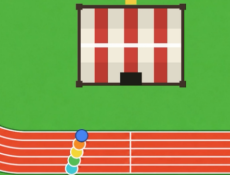
Track Star is an athletics game built around four events that test running speed, jump timing, and consistency. There is no story mode or character-based campaign. Players choose a nation and then move through a short track-and-field competition where each discipline has its own qualifying goal. The objective is to record fast sprint times and long jump distances while performing well enough to continue through the full event sequence.



Track Star
Advertisement
Advertisement





Track Star is an athletics game built around four events that test running speed, jump timing, and consistency. There is no story mode or character-based campaign. Players choose a nation and then move through a short track-and-field competition where each discipline has its own qualifying goal. The objective is to record fast sprint times and long jump distances while performing well enough to continue through the full event sequence.
Build Speed With the Running Controls
Running uses the Left and Right Arrow keys, which must be pressed rapidly in alternation to increase the athlete’s speed. The faster and more consistently the player maintains this rhythm, the better the result in sprint-based sections. Space is used for jumping, but its role changes depending on the current event. This small control set means that most of the difficulty comes from timing rather than learning complicated commands.
Compete in Four Events
Track Star contains four main disciplines, each focusing on a different combination of speed and timing. The events are presented as separate challenges rather than traditional levels with enemies or exploration.
Players compete in:
- the 100 Meter Sprint;
- the 110 Meter Hurdles;
- the Triple Jump;
- the Long Jump.
The 100 Meter Sprint is the most direct event because the player simply tries to build maximum speed and reach the finish as quickly as possible. The hurdles event adds repeated Spacebar timing, requiring the athlete to clear each barrier without breaking running rhythm.
The jumping events work differently because the approach run is only the first part of the attempt. In Long Jump, the player must build enough speed and trigger the jump close to the takeoff point without leaving too early or too late. Triple Jump extends this idea across several consecutive takeoffs, so keeping momentum through the full sequence becomes important. Distance becomes the main measurement instead of race time.
Improve Each Result
Track Star does not use a large campaign or upgrade system. Progress comes from completing the four-event competition and improving performance through repeated attempts. A weak sprint can usually be improved by finding a faster input rhythm, while poor jump distances often indicate a problem with takeoff timing rather than speed alone.
The challenge is switching quickly between different requirements. One event rewards nonstop rapid input, another combines speed with repeated hurdle timing, and the jumping disciplines ask the player to convert a fast approach into an accurate takeoff. Strong overall results depend on handling all four disciplines well instead of relying on one event alone.
Comments (0)


2026
